


Home / Fire-retardant paint
Fire-retardant paint and fire classes
Fire-retardant paint and fire classes.
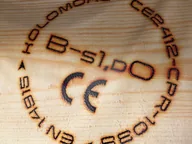
Fire-retardant paint is Kolomore’s most important area today. Since 2020 we have developed fire protection for wood together with Burnblock, and since 2021 we have held a CE certificate under EN 14915 for painting timber profiles. In 2025, most of Teknos’ fire-retardant paint systems for wood were included in Kolomore’s CE certification.
Here you will find the four routes to a fire class, the selection guide and the documentation in one place.
Good to know about class D
Class D must also be documented.
Wood may only be used as class D in construction when it can be documented that the wood, with its surface treatment, meets class D. This also applies when the wood is painted with ordinary paint.
That is why we use specific products, and we document that they are applied in the approved quantity.
The fire classes
The fire classes in brief.
The fire class is given according to EN 13501-1. These are the classes that Kolomore’s fire-retardant paint and fire-neutral painting are about.
- Class B
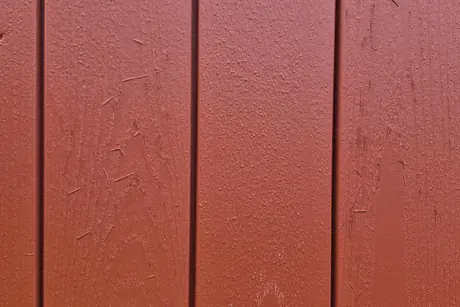
- B-s1,d0We are CE certified to supply fire-retardant coated wood in class B-s1,d0 to EN 14915. Class B is achieved either with intumescent fire-retardant coating on class D wood or with fire-neutral painting of class B wood impregnated with Burnblock.
- Class D
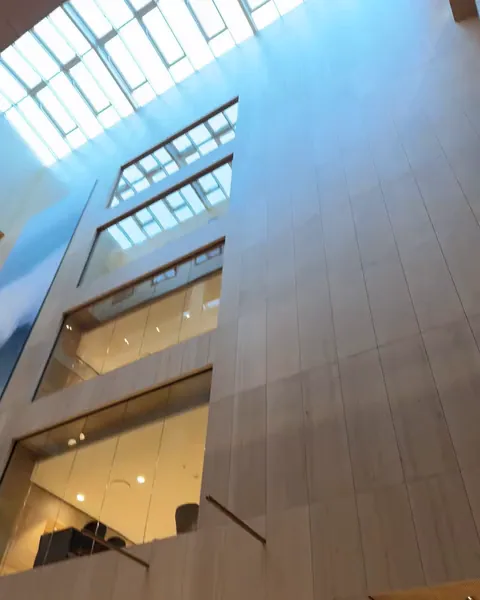
- D-s2,d0We supply painted wood that is documented to meet class D-s2,d0. When wood is painted, it loses its D classification, and the law requires an SBI test documenting that the fire class is intact after the painting process.
The SBI test
How an SBI fire test works, and how a building material gets its fire class.
When building materials such as wall cladding, ceiling panels or fixed fittings are to be approved for use in construction, they must go through a standardised European fire test called an SBI test (Single Burning Item). The test is designed to imitate a very specific real-life scenario: what happens if a single item, for example a waste-paper basket, catches fire in the corner of a room?
Here is an insight into what the material goes through in the test laboratory, and how the measurements are translated into the final fire classification.
1. The set-up: an artificial corner
Before the materials may be used in an SBI test, they must be conditioned, so it is documented that, for example, a material to be tested does not have an artificially high moisture content.
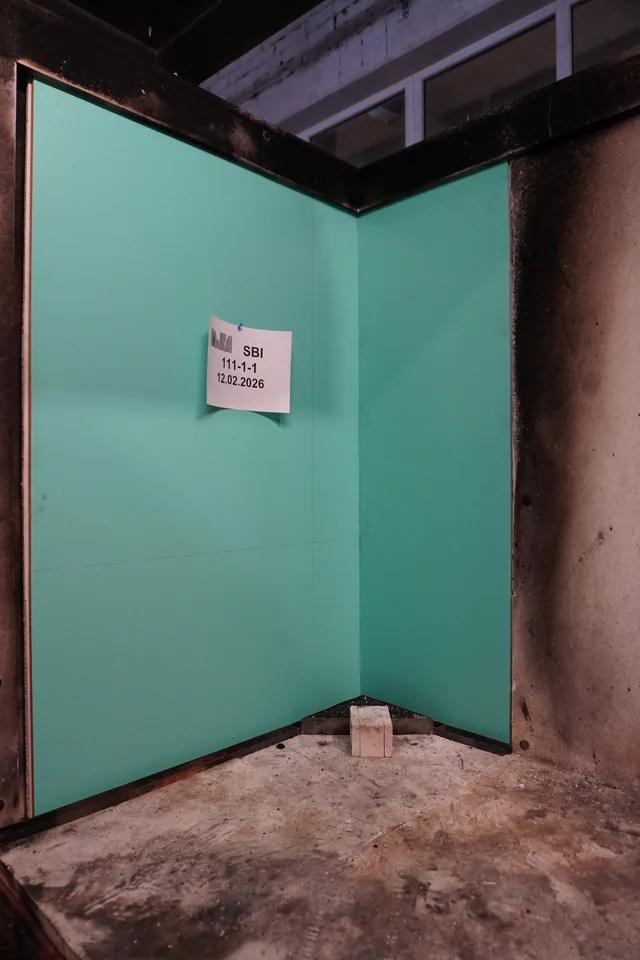
Before the test begins, a test corner is built in a fire-resistant test room. The material is mounted on two panels that stand at right angles to each other like an inside corner of a room (one panel is about 0.5 metres wide, the other 1 metre wide, and both are 1.5 metres high).
To make the test as realistic as possible, the material is mounted in exactly the same way as it will be installed on a building site: with the same screws, joints and any cavities behind.
2. The fire test: 20 minutes of direct flames
Once the test corner has been moved under a large hood in the test room, the actual test begins:
- Warm-up and zeroing: First the equipment measures the air in the room, and a gas burner is lit away from the material for 3 minutes. This is done to measure how much heat and smoke the burner itself produces, so it can be subtracted later.
- The fire itself: Then the main burner, which stands right at the bottom of the corner, is lit. It burns with a powerful, controlled gas flame (about 30 kW, or a good, powerful wood stove) straight up the corner for 20 minutes.
3. What is measured?
While the flames lick up the corner, all the smoke is drawn up through the hood into a measuring duct. Here advanced sensors and a fire technician keep an eye on three crucial things:
- Heat and flame spread: How quickly does the fire take hold of the material, and how much extra heat does it develop? The technician also watches whether the flames manage to spread all the way to the edge of the 1-metre-wide panel.
- Smoke production: A light beam through the exhaust duct measures how dense and dark the smoke becomes. In a real fire, the smoke is often more dangerous to people than the fire itself.
- Burning droplets: The technician observes whether the material melts and drips burning droplets or glowing particles that can spread the fire to the floor.
4. How the measurements become a fire class
After the test, all the data are added up and compared with fixed European limit values. The result is an overall fire class, for example B-s1,d0, which is a typical requirement for materials to be used indoors in larger buildings.
The code consists of three parts, each telling its part of the story:
- The letter (A2, B, C or D), the reaction to fire itself: Shows how much the material contributes to the fire. The closer to A, the less heat the material develops and the harder it is for the fire to spread. (Class A1 is completely non-combustible materials such as concrete and steel, which are tested in a different way.)
- The s number (s1, s2 or s3), the smoke: Tells how much smoke the material gives off. s1 means minimal smoke production, while s3 means heavy smoke.
- The d number (d0, d1 or d2), burning droplets: Shows whether the material drips when it burns. d0 means that no burning droplets fall at all during the entire test.
In short, the SBI test ensures that we know in advance exactly how a building material behaves in the critical first minutes of a fire, so buildings can be designed safely.
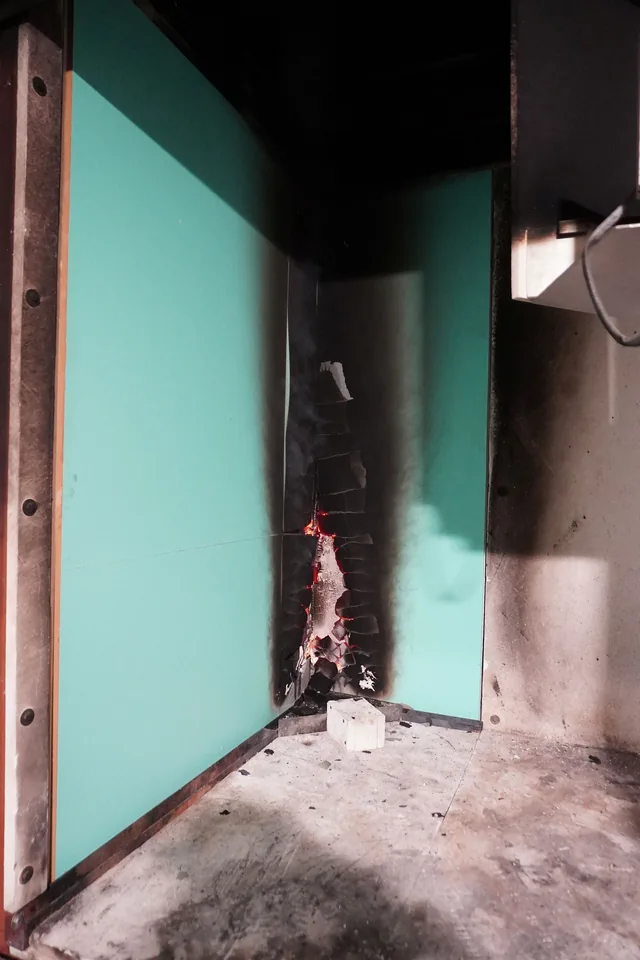
The pictures are from the test of Kolomore’s furniture system on 12 mm fire-impregnated MDF at MeKA in February 2026. The flame did not reach the edge of the specimen, and it was graded B, the smoke corresponded to s1, and no burning droplets fell (d0).
Read about the furniture system on MDF.
Four routes
Four routes to a fire class.
- 06Fire-retardant coating of woodIntumescent paint up to B-s1,d0Traverse line Profile line
- 07Fire-neutral painting of wood, class BBurnblock-impregnated wood with CE markingTraverse line Profile line
- 08Fire-neutral painting of wood, class DDocumented to keep class DTraverse line Profile line
- MDFFire-neutral painting of MDF, class BUV primer and water-based topcoat on fire-impregnated MDF from 12 mmTraverse line UV roller line
Do the profiles need to be adjustable on site? See the difference between the two routes to class B.
From production
Fire-neutral clear lacquer on glulam.
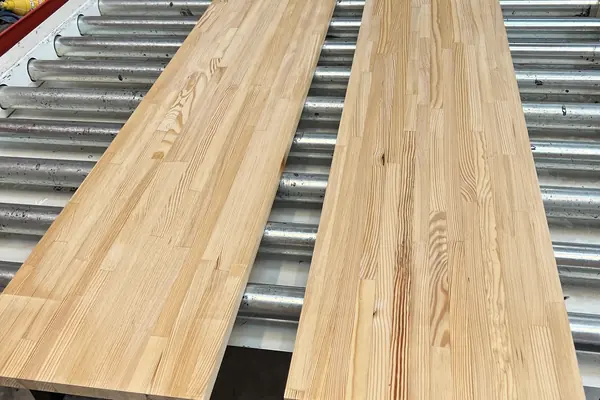
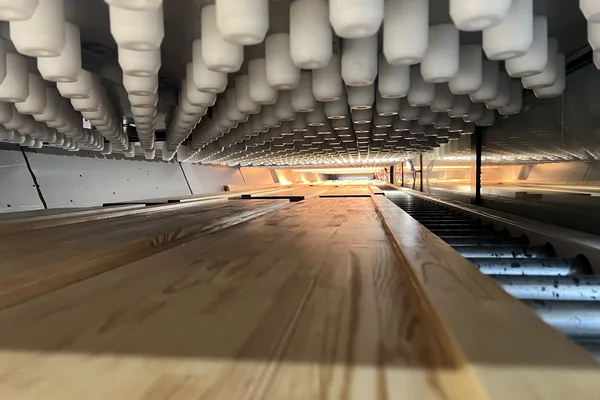
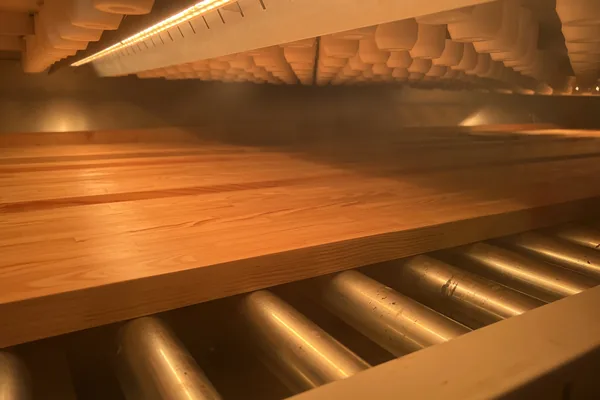
Glulam impregnated with Burnblock and painted with fire-neutral clear lacquer from Burnblock, on its way through the oven.
Selection guide
Find the right combination.
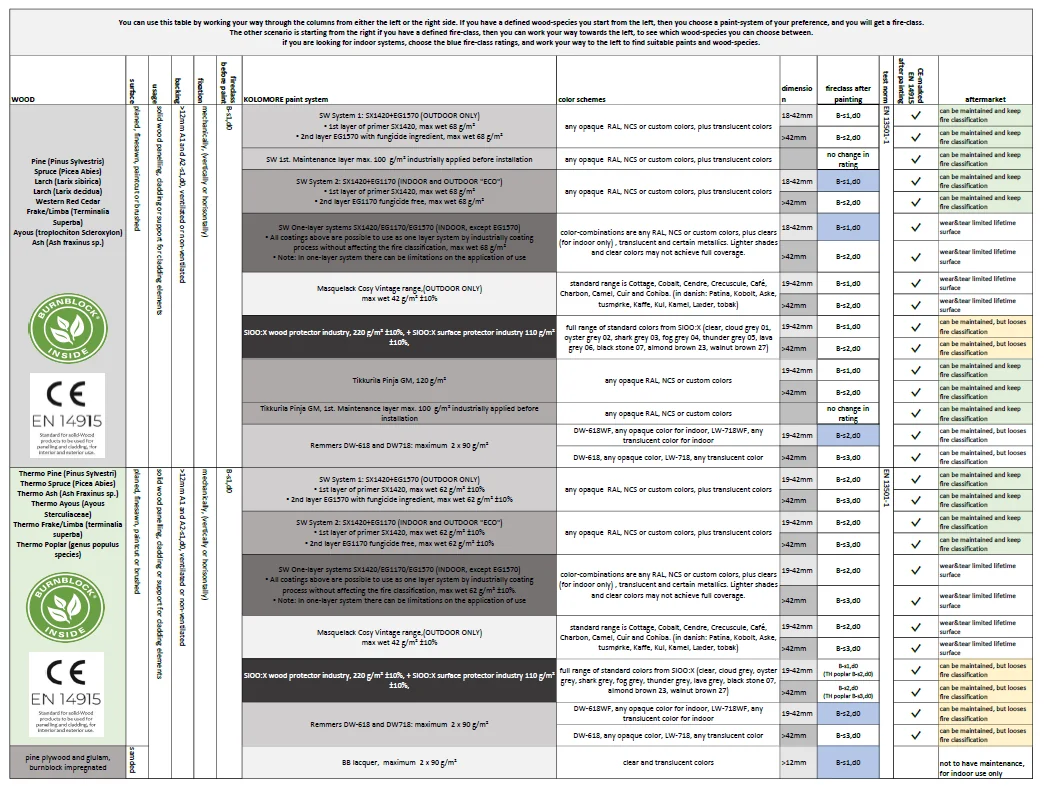
The guide is based on the appendices to our CE certificate, on Kolomore’s chart for wood that is not fire-impregnated, and on the SBI test of the furniture system on fire-impregnated MDF. Choose the wood, the thickness (for Burnblock-impregnated wood), whether it will be outdoors or indoors, and the fire class you need. It then shows the paint systems that fit.
The certificate is being updated. The new edition, 2412-CPR-1035-09, has been issued as a draft by Control Union and becomes valid once it is signed. The selection guide follows the appendices of the draft. The valid certificate is 1035-08 of 4 July 2025.
Result
Without JavaScript, both charts and the furniture system on MDF are listed here, wood by wood. The fire class applies after painting and depends on the thickness of the wood.
Burnblock-impregnated wood
Spruce (Picea abies), pine (Pinus sylvestris), larch (Larix sibirica and Larix decidua), western red cedar (Thuja plicata), frake/limba (Terminalia superba), ayous (Triplochiton scleroxylon), ash (Fraxinus sp.) and Douglas fir (Pseudotsuga menziesii)
- Surface
- Planed, fine-sawn, paintcut or brushed
- Application
- Solid wood panels and cladding
- Impregnation
- Burnblock JG30, industrial vacuum-pressure impregnation at CE-certified subcontractors
- Backing
- A board of class A1 or A2-s1,d0, at least 12 mm and at least 525 kg/m³, or a fibre-cement board of class A2-s1,d0, at least 4.5 mm and at least 1,300 kg/m³
- Air gap
- Ventilated, non-ventilated or none. Battens of class D-s2,d0 or better
- Mounting
- Mechanical, vertical or horizontal
- Without paint
- B-s1,d0 at 15-50 mm and B-s2,d0 over 50 mm. Thermo poplar: B-s2,d0 and B-s3,d0
- Tested to
- EN 13501-1. CE to EN 14915 after painting, under certificate 2412-CPR-1035-09, which is a draft
- Maintenance
- Not covered by the CE certificate. What the cards say about maintenance comes from Kolomore’s chart. Ask us what applies to your system
Outdoor only
Sherwin-Williams System 1: SX1420 + EG1570
1st coat primer SX1420, max. 62 g/m² wet. 2nd coat EG1570 with fungicide, max. 62 g/m² wet.
Thickness and fire class after painting Thickness Fire class after painting 18-42 mm, minimum profile 12 mm B-s1,d0 Over 42 mm B-s2,d0 Indoor only
Sherwin-Williams System 2: SX1420 + EG1170 (ECO)
1st coat primer SX1420, max. 62 g/m² wet. 2nd coat EG1170 without fungicide, max. 62 g/m² wet.
Thickness and fire class after painting Thickness Fire class after painting 18-42 mm, minimum profile 12 mm B-s1,d0Blue in the chart: indoor Over 42 mm B-s2,d0 Indoor only
Sherwin-Williams single-coat system: SX1420, EG1170 or EG1570
All the coatings above can be used as a single-coat system with industrial application without affecting the fire class, max. 62 g/m² wet. Indoor, except EG1570. As a single-coat system, there may be restrictions on use.
Thickness and fire class after painting Thickness Fire class after painting 18-42 mm, minimum profile 12 mm B-s1,d0Blue in the chart: indoor Over 42 mm B-s2,d0 Outdoor only
Masquelack Cosy Vintage
Max. 42 g/m² ±10% wet.
Thickness and fire class after painting Thickness Fire class after painting 19-42 mm B-s1,d0 Over 42 mm B-s2,d0 Outdoor only
SIOO:X Primer Wood Protector Industry and Surface Protector Industry
2 coats of Primer Wood Protector Industry, max. 225 g/m² wet in total, and 1 coat of Surface Protector Industry, max. 115 g/m² wet.
Thickness and fire class after painting Thickness Fire class after painting 19-42 mm B-s1,d0 Over 42 mm B-s2,d0 Outdoor only
Tikkurila Pinja Protect GM
1 coat of Pinja Protect GM, max. 120 g/m², or 2 coats of max. 120 g/m² each, max. 240 g/m² in total.
Thickness and fire class after painting Thickness Fire class after painting 22-42 mm, tongue and groove, minimum profile 13 mm B-s2,d0 Over 42 mm B-s3,d0 Fjällpanel with shiplap joint, 13-30 mm, profile as tested B-s2,d0 Outdoor only
Remmers Induline for outdoor use: T-678 Plus or T-778 Plus
2 coats of approx. 90 g/m² wet each, max. 180 g/m² in total, also as a single-coat system. T-678 Plus is opaque and T-778 Plus translucent, both with fungicide.
Thickness and fire class after painting Thickness Fire class after painting 18-42 mm, tongue and groove or shiplap, minimum profile 12 mm B-s2,d0 Over 42 mm B-s3,d0 Indoor only
Remmers Induline WF for indoor use: T-677 Plus WF or T-777 Plus WF
2 coats of approx. 90 g/m² wet each, max. 180 g/m² in total, also as a single-coat system. T-677 Plus WF is opaque and T-777 Plus WF translucent, both without fungicide.
Thickness and fire class after painting Thickness Fire class after painting 18-42 mm, tongue and groove or shiplap, minimum profile 12 mm B-s2,d0Blue in the chart: indoor Over 42 mm B-s3,d0
Thermally modified wood, Burnblock-impregnated
Thermo pine, thermo ash, thermo ayous, thermo spruce, thermo frake/limba, thermo poplar, thermo tulipwood (Liriodendron tulipifera) and thermo radiata pine (Pinus radiata)
- Surface
- Planed, fine-sawn, paintcut or brushed
- Application
- Solid wood panels and cladding
- Impregnation
- Burnblock JG30, industrial vacuum-pressure impregnation at CE-certified subcontractors
- Backing
- A board of class A1 or A2-s1,d0, at least 12 mm and at least 525 kg/m³, or a fibre-cement board of class A2-s1,d0, at least 4.5 mm and at least 1,300 kg/m³
- Air gap
- Ventilated, non-ventilated or none. Battens of class D-s2,d0 or better
- Mounting
- Mechanical, vertical or horizontal
- Without paint
- B-s1,d0 at 15-50 mm and B-s2,d0 over 50 mm. Thermo poplar: B-s2,d0 and B-s3,d0
- Tested to
- EN 13501-1. CE to EN 14915 after painting, under certificate 2412-CPR-1035-09, which is a draft
- Maintenance
- Not covered by the CE certificate. What the cards say about maintenance comes from Kolomore’s chart. Ask us what applies to your system
Outdoor only
Sherwin-Williams System 1: SX1420 + EG1570
1st coat primer SX1420, max. 62 g/m² wet. 2nd coat EG1570 with fungicide, max. 62 g/m² wet.
Thickness and fire class after painting Thickness Fire class after painting 18-42 mm, minimum profile 12 mm B-s2,d0 Over 42 mm B-s3,d0 Indoor only
Sherwin-Williams System 2: SX1420 + EG1170 (ECO)
1st coat primer SX1420, max. 62 g/m² wet. 2nd coat EG1170 without fungicide, max. 62 g/m² wet.
Thickness and fire class after painting Thickness Fire class after painting 18-42 mm, minimum profile 12 mm B-s2,d0 Over 42 mm B-s3,d0 Indoor only
Sherwin-Williams single-coat system: SX1420, EG1170 or EG1570
All the coatings above can be used as a single-coat system with industrial application without affecting the fire class, max. 62 g/m² wet. Indoor, except EG1570. As a single-coat system, there may be restrictions on use.
Thickness and fire class after painting Thickness Fire class after painting 18-42 mm, minimum profile 12 mm B-s2,d0 Over 42 mm B-s3,d0 Outdoor only
Masquelack Cosy Vintage
Max. 42 g/m² ±10% wet.
Thickness and fire class after painting Thickness Fire class after painting 19-42 mm B-s2,d0 Over 42 mm B-s3,d0 Outdoor only
SIOO:X Primer Wood Protector Industry and Surface Protector Industry
2 coats of Primer Wood Protector Industry, max. 270 g/m² wet in total, and 1 coat of Surface Protector Industry, max. 115 g/m² wet.
Thickness and fire class after painting Thickness Fire class after painting 19-42 mmThermo pine, thermo ash, thermo ayous, thermo spruce, thermo frake/limba, thermo tulipwood and thermo radiata pine B-s1,d0 Over 42 mmThermo pine, thermo ash, thermo ayous, thermo spruce, thermo frake/limba, thermo tulipwood and thermo radiata pine B-s2,d0 19-42 mmThermo poplar B-s2,d0 Over 42 mmThermo poplar B-s3,d0 Outdoor only
Remmers Induline for outdoor use: T-678 Plus or T-778 Plus
2 coats of approx. 90 g/m² wet each, max. 180 g/m² in total, also as a single-coat system. T-678 Plus is opaque and T-778 Plus translucent, both with fungicide.
Thickness and fire class after painting Thickness Fire class after painting 18-42 mm, tongue and groove or shiplap, minimum profile 12 mm B-s2,d0 Over 42 mm B-s3,d0 Indoor only
Remmers Induline WF for indoor use: T-677 Plus WF or T-777 Plus WF
2 coats of approx. 90 g/m² wet each, max. 180 g/m² in total, also as a single-coat system. T-677 Plus WF is opaque and T-777 Plus WF translucent, both without fungicide.
Thickness and fire class after painting Thickness Fire class after painting 18-42 mm, tongue and groove or shiplap, minimum profile 12 mm B-s2,d0Blue in the chart: indoor Over 42 mm B-s3,d0
Plywood and glulam of pine, Burnblock-impregnated
Sanded plywood and glulam of pine
- Surface
- Sanded
Indoor only
BB lacquer
Max. 2 x 90 g/m².
Thickness and fire class after painting Thickness Fire class after painting Over 12 mm B-s1,d0Blue in the chart: indoor
Other wood or wood-based panels that have not been fire-retardant impregnated
Solid wood, MDF, OSB, plywood, glulam and much more
Solid wood, MDF, OSB, plywood, glulam and much more. The wood does not need fire-retardant impregnation. With fire-retardant paint, an intumescent paint, we can paint up to B-s1,d0. The paint is from Teknos, Sherwin-Williams, TREET and Masquelack. Cutting to length and adjusting on site destroy the fire protection, so cut surfaces must be touched up with fire-retardant paint on site. See fire-retardant coating of wood.
- Fire class before painting
- D-s2,d0
- Mounting
- Mechanical, vertical or horizontal
- Density
- Over 338 kg/m³. Timber battens: over 400 kg/m³
- Backing
- Over 12 mm A1 and A2-s1,d0, ventilated or non-ventilated depending on the system and number of painted sides. Timber battens: A2-s1,d0, non-ventilated
- Tested to
- EN 13501-1. CE to EN 14915 is shown for the systems our certificate covers. The others are fire tested but not CE-marked by us
- Maintenance
- Not covered by the CE certificate. What the cards say about maintenance comes from Kolomore’s chart. Ask us what applies to your system
The chart does not say indoor or outdoor
Teknos FR Panel system: TEKNOSAFE 2407 and TEKNOCLAD 3371
Over 350 g/m² TEKNOSAFE 2407 on all sides and under 100 g/m² TEKNOCLAD 3371 as a topcoat on the visible sides.
Wood, surface, thickness and fire class after painting Wood, surface and thickness Fire class after painting Solid spruce or spruce glulamPlaned, fine-sawn, paintcut or brushed. Over 19 and under 57 mm B-s1,d0 SP-105 Outdoor only
Teknos FR Panel system: TEKNOSAFE 2407 and Flame Protect 2408
At least 350 g/m² ±10% TEKNOSAFE 2407-00 as primer and 150 g/m² ±10% TEKNOSAFE Flame Protect 2408 as topcoat, measured wet. Teknol Aqua 1410-01 wood protection, 100-120 g/m², can be used under the primer.
Wood, surface, thickness and fire class after painting Wood, surface and thickness Fire class after painting Solid spruceFine-sawn. 19-57 mm, minimum profile 9.5 mm B-s1,d0 The chart does not say indoor or outdoor
Teknos FR Panel system: TEKNOSAFE 2407 and NORDICA ECO 3330-03
Over 350 g/m² TEKNOSAFE 2407 on all sides and under 150 g/m² NORDICA ECO 3330-03 as a topcoat on the visible sides.
Wood, surface, thickness and fire class after painting Wood, surface and thickness Fire class after painting Solid spruce or spruce glulamPlaned, fine-sawn, paintcut or brushed. Over 19 and under 57 mm B-s1,d0 SP-105 The chart does not say indoor or outdoor
TREET NORFLAM W312
Over 350 g/m² on 4 sides.
Wood, surface, thickness and fire class after painting Wood, surface and thickness Fire class after painting All wood species with a density over 338 kg/m³ and thermo pineFine-sawn and rough. Over 9 mm B-s1,d0 The chart does not say indoor or outdoor
TREET NT Deco
Over 350 g/m² on 4 sides.
Wood, surface, thickness and fire class after painting Wood, surface and thickness Fire class after painting Any wood substrate with a density over 338 kg/m³, including CLT, LVL and glulamFine-sawn, rough, paintcut or coarsely sanded. Over 18 mm B-s1,d0 Indoor only
TREET NORFLAM W212
Over 350 g/m² on 4 sides, or 3 sides without an air gap behind.
Wood, surface, thickness and fire class after painting Wood, surface and thickness Fire class after painting MDF, plywood, OSB, oak, ash and pineFine-sawn, rough or paintcut. Over 9 mm B-s1,d0Blue in the chart: indoor Indoor only
TREET NT Deco
Over 350 g/m² on 4 sides.
Wood, surface, thickness and fire class after painting Wood, surface and thickness Fire class after painting Any wood substrate with a density over 338 kg/m³, including CLT, LVL and glulamFine-sawn, rough, paintcut or coarsely sanded. Over 18 mm B-s1,d0Blue in the chart: indoor Indoor only
TREET Norflam TP and NORFLAM TP01
Over 200 g/m² Norflam TP on 4 sides and 220 g/m² NORFLAM TP01 on the visible side. Norflam TP only provides fire protection, not a resistant surface.
Wood, surface, thickness and fire class after painting Wood, surface and thickness Fire class after painting Plywood, OSB, MDF and similarPlaned (and sanded), fine-sawn, paintcut or brushed. Over 9 mm B-s1,d0Blue in the chart: indoor Indoor only
Sherwin-Williams IM1000-0005
Over 300 g/m² on 1 side.
Wood, surface, thickness and fire class after painting Wood, surface and thickness Fire class after painting Plywood, pine and birchSanded. Over 12 mm B-s1,d0Blue in the chart: indoor Plywood, pine and birch, perforated Ø10 CC20Sanded. Over 12 mm B-s1,d0Blue in the chart: indoor OakPlaned. Over 16 mm B-s1,d0Blue in the chart: indoor Indoor only
Teknos TEKNOSAFE Flameguard 2467-10 and Flame Protect 2468-00
Over 250 g/m² TEKNOSAFE Flameguard 2467-10 and under 100 g/m² TEKNOSAFE Flame Protect 2468-00.
Wood, surface, thickness and fire class after painting Wood, surface and thickness Fire class after painting Any wood substrate with a density over 338 kg/m³, including CLT, LVL and glulamAll surfaces. Over 8 mm B-s1,d0Blue in the chart: indoor Indoor only
Teknos TEKNOSAFE Flameguard 2457-10 and Flame Protect 2458-00
Over 250 g/m² TEKNOSAFE Flameguard 2457-10 and at most 100 g/m² TEKNOSAFE Flame Protect 2458-00, or one of the other topcoats in appendix 2.
Wood, surface, thickness and fire class after painting Wood, surface and thickness Fire class after painting Any wood substrate with a density over 338 kg/m³, including CLT, LVL and glulamAll surfaces. Over 8 mm B-s1,d0Blue in the chart: indoor The chart does not say indoor or outdoor
TREET Thermoblack
Over 350 g/m² on 4 sides.
Wood, surface, thickness and fire class after painting Wood, surface and thickness Fire class after painting Thermo spruceFine-sawn and rough. Over 19 mm D-s1,d0 The chart does not say indoor or outdoor
TREET NORFLAM W313
Over 250 g/m² on 3 sides.
Wood, surface, thickness and fire class after painting Wood, surface and thickness Fire class after painting Thermo spruce and thermo pineFine-sawn and rough. Over 19 mm D-s1,d0 Indoor only
Teknos TEKNOSAFE Flameguard 2467-00, with or without Flame Protect 2468-00
Over 250 g/m² TEKNOSAFE Flameguard 2467-00, with or without under 80 g/m² TEKNOSAFE Flame Protect 2468-00.
Wood, surface, thickness and fire class after painting Wood, surface and thickness Fire class after painting Solid timber battens, 20 x 40 mmPlaned. Max. 1.72 m² visible surface per 1.0 m². 20 x 40 mm B-s1,d0Blue in the chart: indoor Indoor only
Teknos TEKNOSAFE Flameguard 2467-00 and Flame Protect 2468-00
Over 250 g/m² TEKNOSAFE Flameguard 2467-00 and under 80 g/m² TEKNOSAFE Flame Protect 2468-00.
Wood, surface, thickness and fire class after painting Wood, surface and thickness Fire class after painting Solid timber battens, 40 x 40 mmPlaned. Max. 1.72 m² visible surface per 1.0 m². 40 x 40 mm B-s1,d0Blue in the chart: indoor
Fire-impregnated MDF in class B
MDF from 12 mm that is itself classified B-s1,d0, from any supplier, e.g. for shop fittings
We prime with UV roller coating and topcoat with water-based spray painting in all colours and clear lacquer. See fire-neutral painting of MDF.
- Substrate
- MDF boards classified B-s1,d0 from any supplier, from 12 mm
- Primer
- UV roller coating
- Topcoat
- Water-based spray painting
- Tested
- SBI test to EN 13823 at MeKA, February 2026
- CE
- Not yet included in our CE marking. That requires more fire tests
Indoor fittings and furniture
Kolomore’s furniture system: UV primer and water-based topcoat
Priming by UV roller coating and topcoat with water-based spray painting, giving a furniture-quality surface.
Panel, thickness and fire class after painting Panel and thickness Fire class after painting MDF in class B-s1,d0, any supplierFrom 12 mm B-s1,d0
The chart has no combination with those choices. Go back one step, or ask us.
Tests and standards
What Teknos states.
Teknos states this in the technical data sheets for the TEKNOSAFE products. The classes apply to Teknos’ systems on the substrates and with the amounts described in the classification reports. Ask us what applies to your project.
- Exterior · Teknos FR FaçadeTEKNOSAFE 2407-00
- Fire class B-s1,d0 or B-s2,d0 according to EN 13501-1 (SBI test) in certain systems. Durability of the reaction to fire performance according to EN 16755: DRF class EXT. The opaque facade system is classified according to SP Fire 105 and has fire resistance K1 10 and K2 10.
- Interior · Teknos FR PanelTEKNOSAFE FLAME GUARD 2457-10
- With FLAME PROTECT 2458-00: fire class B-s1,d0 according to EN 13501-1 (SBI test) in certain systems. Durability of the reaction to fire performance according to EN 16755: DRF class INT1 and INT2. Indoor air: A+ under the French labelling.
- Interior · Teknos FR PanelTEKNOSAFE FLAME GUARD 2467-10
- With FLAME PROTECT 2468-00: fire class B-s1,d0 according to EN 13501-1 (SBI test). Durability of the reaction to fire performance according to EN 16755: DRF class INT1 and INT2. Indoor air: M1 and A+ under the French labelling.
Fire protection documentation
DoP, CE certificate and data sheets.
Declarations of performance (DoP) 7 files
Certificates and classification 3 files
The certificate is being updated. The new edition, 2412-CPR-1035-09, has been issued as a draft by Control Union and becomes valid once it is signed. The file here is the valid edition, 1035-08 of 4 July 2025.
Safety data sheets 29 files
Safety data sheets, Danish 8 files
Safety data sheets, English 21 files
- Burnblock Lacquer
- EG1170-92512
- EG1170-92532
- EG1570-92512
- EG1570-92532
- Norflam TP
- Norflam W313
- NT Deco
- NT Thermo Black
- Remmers DW-618
- Remmers LW-718
- SiOO:X Premium Surface Protection Deck
- SiOO:X Premium Wood Protection
- SX1420-9024
- Teknoclad 3371
- Teknosafe 2407-00
- Teknosafe Flame Guard 2467
- Teknosafe Flame Protect 2408
- Teknosafe Flame Protect 2458
- Teknosafe Flame Protect 2468
- WB Cosy Vintage
Do you need fire-classified wood?
Tell us about the project, the wood species and the fire class you need to achieve, and we will help you choose a system.
Get a quote

Bo Hjorth Jensen founder and CEOCall +45 93 96 18 28Email bhj@kolomore.com
Business customers only. No sales to private customers